.gif)
Bartering
Before the traditional cash system developed, there had been no consistent means of payment. It was the time of dinosaurs bartering.
Bartering means exchanging one’s goods or services in return for another’s. Before cash, bartering was the most common and popular way to obtain anything you might need for life and business.
Let’s take an example to illustrate how it works. Imagine people in funny old-time clothes. If a baker wanted to buy some milk, they would offer the farmer bread in return for it. Thus, two loaves of bread in return for a liter of milk.
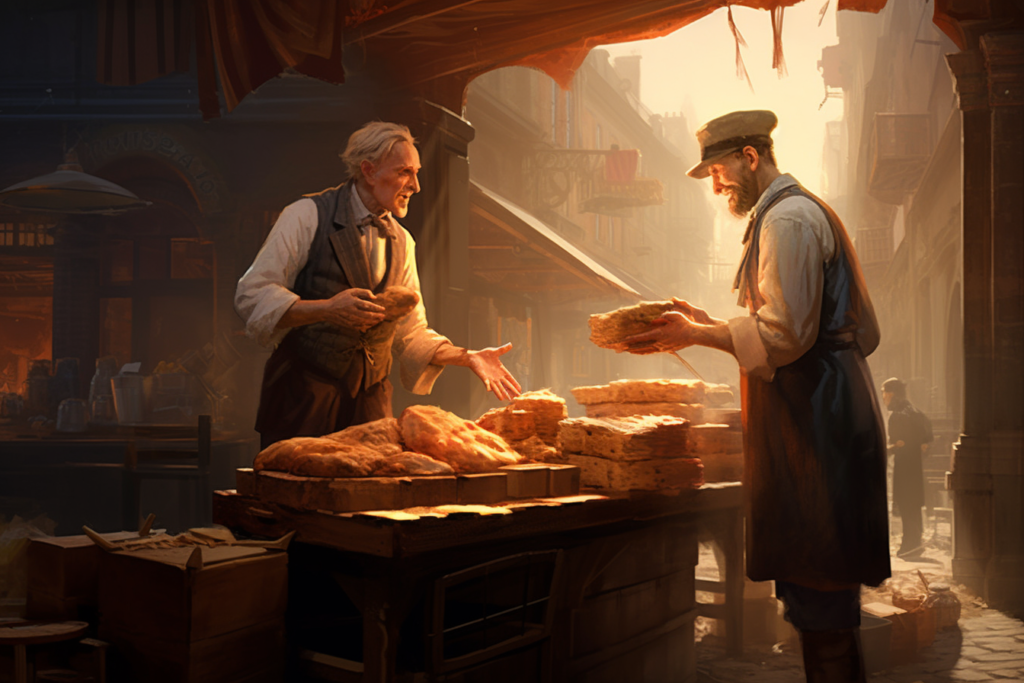
There is a problem with bartering, though. The person you’re purchasing the goods/service from may not need or value what you’re offering. Maybe the farmer already has enough bread and needs something else, like a rope. Maybe they’re gluten intolerant. In any case, the baker is in a bad situation. They have two options now:
- To search for someone who has a rope and wants bread > to trade > to go to the farmer > to trade the rope for milk
- To flip the farmer the bird and look for someone else who has milk but needs bread
It’s like a bad quest in a fantasy game.
Another problem with the bartering system is divisibility. You can’t divide things into smaller parts. If all the farmer has to trade is a cow, and they want grains to grow new crops… What are they to do? They can’t sell a cow’s leg and get a bag of grain, retaining the cow’s initial value. No one needs a three-legged cow. And if the farmer sells their cow whole, they will get ×10 bags of grain, which they don’t have time to plant. Depending on a person’s needs, the value of something small could be greater than something big, like grain and a cow.
Commodity money
Over time, bartering was replaced with commodity money. Commodity money is a type of good that functions as a currency. Commodity money has certain characteristics: widely desired, therefore creating value, but also portable, durable, and easily stored.
Some early examples of commodity monies were animal skin and dried corn. However, these all were later replaced with precious metals, like gold.
In terms of practicality, gold wasn’t particularly useful. You can’t eat it, and it won’t keep you warm when it’s cold. But the majority of people find it beautiful, and they know other people think it’s beautiful too.
Gold is useless… but it shines so prettily. This metal became valuable because we all agree it has value. Gold’s appearance, relative scarcity, and the difficulty of extraction only added to our perception of it as an expensive item.
Paper money and coins
However, gold also had problems with divisibility. It is virtually impossible to go to the market with a brick of gold to buy some milk and bread. Because of this, and due to some other problems like weight, came the development of paper money and coins. Many countries have tied the value of their new currencies to gold. The US dollar was one such example.
The gold was held by a national central bank. During the time of the gold standard, this precious metal was used as a guarantee. It guaranteed the country would fulfill its promises and pay depositors, holders of paper money, and trading peers. Like beauty, gold was a promise of happiness and a warranty that the value of the national currency is supported by valuable metals. Some countries stored gold to give value to their paper currency. The US was among them.
The gold standard implies that the entire state’s money supply is backed by gold. In this system, central banks are obliged to guarantee the exchange of banknotes for gold at a fixed rate. At the time of the gold standard, central banks set the exchange rates between different currencies.
However, history shows that the gold standard doesn’t guarantee price stability.
During the Second World War, the US had many allies paying for military supplies and other materials and goods in gold. So, by the end of the war, the United States had held 75% of the world’s monetary gold reserve, and the dollar had been the only currency still directly backed by it.
Nonetheless, some problems appeared after WWII. As the world rebuilt itself, the US quickly found that they had spent most of their reserves. The scarcity of gold led to problems with the inability to mine enough of it to cope with economic growth. Also, the value of money to gold wasn’t stable anymore. Gold was once again useless.
As a result, the US government decided to stop backing the dollar with gold in 1971. By doing so, they turned the dollar into what’s known as a fiat currency. Now, not one country in the world uses the gold standard.
Fun fact: Great Britain was the first to drop off the gold standard in 1931.
Fiat currency
A fiat currency is a government-issued currency that is not backed by a physical commodity. Its value comes from the stability of the government, people’s faith in the government, supply, and demand.
Most paper currencies around the world are fiat currencies (e.g., the US dollar and the Euro).
At first, fiat currencies brought calmness and stability to the financial world for a while. However, with the development of technology and payment methods, new problems became more visible in the system.
Problems with centralized currency
When each country’s central bank controls how much money is printed and issued, there can be several problems:
- inflation (increase in prices); and…
- devaluation (reduction in the value of money).
As a result, small groups of people, mainly people in positions of power and wealth, took full control of most currencies.
Ordinary citizens and the majority of the population don’t have any say in how much money would be printed or when. That means that people’s entire life savings could become worthless just because of mistakes or poor decisions at the government level. And that there is nothing they can do about it. This is one of the principal problems with the centralized cash currency system.
Another common problem with a centralized cash currency system is exchange fees. With the development of credit cards and international money transfers, banks and other third-party intermediaries became involved in the payment process.
If you use your credit card to pay for something or send funds to another person, the credit card issuer will usually charge a fee for each transaction. The same happens when you use a wire service to transfer money to your family abroad.
For example, if you are sending money to your brother, and you both have the same bank, there will probably be a small transaction fee as there will be no extra outside parties involved. But if we were to send money to a friend who’s a client of a different bank in some other country, there would be a whole chain of third parties. And the more intermediaries participate in a transaction, the higher the transaction fee will be.
The Crisis of 2008
In 2008, the financial crisis shook the entire world economy. Nowadays, people are wondering what has changed since then and how to avoid similar economic turmoil in the future.
This is the year when it has become explicit that a centralized currency system also has a security problem.
Banks can lose their licenses, go bankrupt, or get hacked, and all the information and money belonging to the customers of such a bank could be stolen and disappear forever. Having a single point of failure makes banks particularly vulnerable. Such dangers became truly visible, with many banks going bankrupt and governments bailing them out with public funds.
Even the famous Netflix drama Money Heist (La Casa de Papel) is a metaphor for the money-printing moves adopted by major central banks in the West in 2008.
In the US, more than 8 million citizens lost their jobs, approximately 2.5 million businesses went bankrupt, and nearly 4 million homes were foreclosed in less than two years. Many people lost faith in the system due to food insecurity and income differentiation.
But without 2008, cryptocurrency may not be what it is today.
Bitcoin is born!
In 2008, we saw the release of the Bitcoin whitepaper written by Satoshi Nakamoto. Published on October 31, 2008, the original thesis paper on Bitcoin sets the basic structure of the Bitcoin network.
To this day, it is still not known who Satoshi is. Is it a pseudonym? Is Satoshi one person or a group of people? There are many theories trying to guess this identity, but none have been confirmed. Satoshi outlined the structure for a new global digital currency that could solve all of the above-mentioned problems. The Bitcoin concept was born.
Bitcoin vs centralized currency
Bitcoin is a decentralized currency. It uses blockchain technology to create a global network of computers that collectively verifies and protects the network against hacking and transaction forgery. Since the network doesn’t have a single point of failure, like a bank, it’s nearly impossible to break or hack it. In order to even try, hackers would need to take control of millions of computers simultaneously.
Bitcoin has incorporated two of the principal security principles of crypto: transparency and trust.
Transparency in the blockchain industry refers to the ability of anyone to view and verify the data on the blockchain. All transactions and data on the blockchain are publicly available, and anyone can inspect the ledger to ensure that all transactions are valid and legitimate. This is made possible by the decentralized and immutable nature of the blockchain, which allows for a transparent and tamper-proof system. Transparency is a key feature of blockchain technology and is essential for building trust and accountability in various industries.
According to Satoshi Nakamoto, the root problem with conventional currencies lies in all the trust that’s required to make them work. The central bank must be trusted not to debase the currency, but the history of fiat currencies is full of breaches of that trust. In crypto, where all processes are automated, the matter of trust is not an issue.
Trust. Since all processes are automated, the participants can be sure that the probability of hacking is minimal. Thus, the trust in each party in the transaction increases. It’s simple: if you aim to buy Bitcoin, you’re very unlikely to get robbed on the way.
Bitcoin’s total emission is set at 21 million. This amount cannot be changed, and more coins cannot be mined. Due to the system created to mine and find the coins, the last coins are not expected to be mined until the year 2120, thus helping the currency deal with problems of inflation and devaluation.
Bitcoin transactions are peer-to-peer based and have low fees. In the Bitcoin network, the following types of fees exist:
- wire fees
- mining fees
- account fees
- spot fees
- tiered transaction fees
Bitcoin is a global currency: you can send it to anyone, anywhere, anytime. Compared to cash, Bitcoin is highly divisible — $1 can be broken down into quarters, dimes, nickels, and pennies, the smallest amount being worth one-hundredth of a dollar, or 0.01 in numerical terms. The smallest unit of a single Bitcoin is one hundred millionth, or 0.00000001 in numerical terms. The name of this tiny unit is a satoshi, sometimes called sats for short.
The disappearance of Satoshi Nakamoto
Bitcoin has had quite a rapid growth since its creation. As mentioned, in 2008, Satoshi Nakamoto published the Bitcoin whitepaper. On January 3, 2009, Nakamoto mined the starting block of the chain, known as the genesis block. This was the date when the Bitcoin network was created.
In December 2010, Satoshi mysteriously disappeared. The famous words —
“I’ve moved on to other things.”
Satoshi Nakamoto
— were among the last things anyone heard from this deity. Bitcoin started living on its own, without the master. It survived the collapse of one of its biggest markets in the early days, the Silk Road, in 2013. And in 2014, it survived the Mt. Gox scandal. 2015 saw Ethereum, which is commonly viewed now as the second main cryptocurrency, go live. In 2017, we witnessed the ICO boom, and Bitcoin hit a record high of almost $20,000. In 2021, Bitcoin’s price increased by over 300% in a year, soaring to $64,000 — the highest it has ever been so far. In 2022, the crypto winter came and set its rules for the market players up to 2023.
Bitcoin now
Many companies have started accepting Bitcoin as a means of payment. At Microsoft, you can pay for Xbox Live and Skype subscriptions. Starbucks lets customers buy drinks and other goods with the Bakkt app. AirBaltic and LOT Polish Airlines both accept Bitcoin payments for flight tickets. PayPal, Home Depot, Etsy… And the list continues to grow.
It’s hard to see the future without the involvement of Bitcoin and other cryptocurrencies. Many well-known and respected figures in the world of tech also seem to have faith in it.
Peter Thiel, the co-founder of PayPal, said, “I do think Bitcoin is the first [encrypted money] that has the potential to do something like change the world.”
Bill Gates called Bitcoin “a techno tour de force,” and Elon Musk stated, “I am a supporter of Bitcoin.”
Other cryptocurrencies
Bitcoin is just the tip of the iceberg.
There are over 20,000 cryptocurrencies, which resolve different tasks and help solve problems in various spheres.
The decentralized world is here! Smart contracts help eliminate third parties, reduce transaction fees, and automate processes. Blockchain technology is also used in the medical sphere by companies like MediLedger and FarmaTrust, which help the pharmaceutical sector verify the authenticity of medicines, assess prescriptions, and track and trace any issues in the supply chain.
Sierra Leone was the first country to use blockchain technology in national elections in early 2018 in order to reduce the chance of corruption and rigged elections. Governments across the world own an estimated 259,870 BTC, representing 1.237% of the total supply.
What the hell is blockchain? How does it work? Can you enlighten me, but in a way so that I don’t fall asleep? Yep, read on.
Comments
Post a Comment